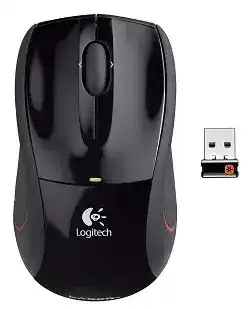
A Logitech Wireless M505 Mouse Driver repair usually starts after the tiny Unifying receiver has been moved, lost, borrowed for another Logitech device, or reinserted into a different USB port. The M505 is a 2.4 GHz wireless laser mouse, not a Bluetooth model, so pairing, receiver recognition, battery power, and SetPoint controls matter more than Bluetooth menus.
This model uses a Logitech Unifying receiver, two AA batteries, an on and off switch, laser tracking, an ambidextrous shape, and soft rubber side grips. It was made as a portable full-size wireless mouse, so many problems come from receiver confusion, old software entries, weak battery contact, fast pointer speed, or button assignments that no longer match the user’s habits.
The operating system may give basic pointer movement when the receiver is accepted. The Logitech utility becomes important when the receiver no longer talks to the mouse, SetPoint cannot see the device, the programmable controls disappear, or the pointer behaves differently after a Windows or Mac update.
Logitech Wireless Mouse M505 Windows Driver Download
| Driver Name | Description | Supported OS | File Size | Download |
|---|---|---|---|---|
| SetPoint 64-bit Software | Full offline SetPoint package for mouse button settings, tracking speed, hot-key control, and device-specific options. | Windows 11, Windows 10 64-bit, Windows 8 64-bit, Windows 7 64-bit | 80.45 MB | |
| SetPoint 32-bit Software | Full offline SetPoint installer for configuring mouse buttons, battery status alerts, Caps Lock, and Num Lock indicators. | Windows 11, Windows 10 32-bit, Windows 8 32-bit, Windows 7 32-bit | 78.04 MB | |
| SetPoint Smart Installer | Small SetPoint web installer for mouse customization and device settings that requires internet during installation. | Windows 11, Windows 10 32-bit/64-bit, Windows 8 32-bit/64-bit, Windows 7 32-bit/64-bit | 4.61 MB | |
| Logitech Unifying Software | Utility for pairing compatible Logitech wireless devices with a Unifying receiver on supported Windows systems. | Windows 11, Windows 10 32-bit/64-bit | 3.96 MB |
Logitech Wireless Mouse M505 Mac OS Driver Download
| Driver Name | Description | Supported OS | File Size | Download |
|---|---|---|---|---|
| Logitech Options Software | Customization software for mouse buttons, pointer behavior, scrolling actions, shortcuts, gestures, and device settings. | macOS 15, macOS 14, macOS 13, macOS 12, macOS 11 | 238.52 MB | |
| Logitech Control Center Software | Mac software for adjusting Logitech mouse controls, scrolling behavior, button actions, and supported device preferences. | macOS 11, macOS 10.15, macOS 10.14, macOS 10.13 | 17.76 MB | |
| Logitech Control Center Software | Control Center package for Mac OS X systems to manage mouse button assignments and device behavior. | Mac OS X 10.13, Mac OS X 10.12, Mac OS X 10.11 | 17.15 MB | |
| Logitech Control Center Software | Legacy Mac package for configuring compatible Logitech mouse functions, click actions, and scrolling preferences. | Mac OS X 10.11, Mac OS X 10.10, Mac OS X 10.9, Mac OS X 10.8 | 17.06 MB |
Start With the Receiver Identity, Not the Mouse Shell
The M505 receiver is small enough to stay in a laptop, but that also makes it easy to mix with another Logitech dongle. A receiver from a non-Unifying model can look similar and still fail. Before changing software, check that the receiver has the Unifying mark and that it has not been swapped with a receiver from a different wireless mouse.
Mouse has power but no pointer movement
When the light shows life but the cursor does nothing, unplug the receiver and connect it again to a direct USB port. Hold the mouse close to the computer during the first test. If the pointer appears for a moment and then stops, treat it as a receiver or pairing problem before looking at click settings.
Run the Unifying pairing utility and pair the M505 again. Turn the mouse off when the utility asks, turn it back on, and wait for the software to confirm the connection. This is the most direct use of the Logitech Wireless M505 Mouse Driver package when the computer sees a receiver but not the mouse.
Replacement receiver does not pair
A replacement must be a compatible Unifying receiver. The M505 cannot pair through Bluetooth and it does not use a Logi Bolt receiver. If a replacement receiver is from another Logitech family, Windows may install it as a USB input device, but the M505 will still remain silent.
If the receiver is valid, remove other inactive Logitech receivers while pairing. Keep only the receiver you want to use connected during the pairing process. This prevents the utility from selecting the wrong USB device and makes the pairing result easier to trust.
Receiver works on one computer but not another
That split usually points to the computer, not the mouse. Try a different USB port, avoid an overloaded hub during testing, and restart after the receiver is detected. On older laptops, the receiver may need a few seconds after login before the pointer begins to move.
If the M505 works on a second computer after pairing, leave the mouse alone and clean up the first system’s input entries. Remove inactive Logitech mouse entries only when they are clearly old or duplicated, then reconnect the receiver and let the system rebuild the device profile.
SetPoint Controls for the M505 Buttons
SetPoint is the older Logitech software normally associated with this model’s cursor, button, and programmable control options. Use it when normal movement works but the button behavior is wrong. Do not expect current gaming software, Bolt tools, or Bluetooth utilities to add support to the M505 hardware.
Programmable controls disappear after reinstalling Windows
After a clean operating-system install, the M505 may move and click without showing its extra control options. Install the matching Logitech Wireless M505 Mouse Driver software, then open the mouse control panel and check the assigned actions. The operating system may only expose left click, right click, and wheel movement until Logitech software adds the model profile.
If the control panel opens but does not list the M505, close it, unplug the receiver, restart, and connect the receiver again before reopening the utility. Pairing first and configuring second avoids a common loop where SetPoint opens, but the device never appears.
Back, forward, or custom actions trigger the wrong command
Button assignments can become mismatched when a profile from another Logitech mouse remains on the computer. Reset the M505 actions in SetPoint and test them in one browser window or a file folder. Do not test in several apps at once, because each app may use mouse buttons differently.
If a button works in one program but not another, the driver is probably not broken. The target app may be ignoring that shortcut or using it for a different command. Assign a simpler action first, confirm the button responds, then change it back to the preferred shortcut.
Middle click is missing in tabs or design software
Middle click depends on the wheel switch and the software assignment. Test it by clicking a web link with the wheel. If the link does not open in a new tab, check SetPoint for the wheel-button action. Assign it back to middle button before replacing the mouse.
When the wheel scrolls but the wheel click feels heavy, unreliable, or triggers only when pressed very hard, the switch may be worn. Software can restore a lost assignment, but it cannot repair a failing wheel switch. Test the same behavior on another computer before deciding.
Pointer Speed, Laser Tracking, and Desk Behavior
The M505 uses laser tracking, which can feel different from a basic optical mouse. A pointer that feels too quick, grabs windows by mistake, or jumps during small movements may not need a new receiver. It may need a surface change, speed adjustment, or a clean sensor opening.
Pointer feels too sensitive on Linux or a fresh system
Some systems load the M505 with acceleration or speed that feels too high. Lower the pointer speed first, then reduce acceleration if the system offers that choice. A high-speed setting can make a normal click look like a drag, especially when trying to move windows or select small text.
Do not judge the mouse only inside a game, remote desktop session, or graphics app. Test movement on the desktop and in a simple file window. If ordinary movement becomes controllable after the speed change, the wireless link is probably fine.
Laser sensor skips on shiny or patterned surfaces
Laser tracking works on many surfaces, but glossy glass, mirror-like tables, deep texture, and high-contrast patterns can still cause strange movement. Put the M505 on a plain matte surface and compare the cursor. If the skip disappears, the surface caused the fault.
Check the sensor opening for dust or hair. Wipe the underside with a dry, soft cloth and avoid liquid near the sensor. Dirt near the lens can make the pointer stutter even when the receiver, batteries, and software are all working correctly.
Lag starts only when the receiver is far away
The M505 uses a 2.4 GHz wireless connection, so placement still matters. A laptop port usually works well because the receiver stays near the mouse. A desktop tower under a desk can create a longer, blocked path. Change the receiver position before changing driver packages again.
Nearby wireless gear, thick metal panels, or a crowded USB hub can add hesitation. Use a direct port for testing and remove unnecessary receivers while diagnosing the issue. If the cursor becomes responsive after the receiver location changes, keep that layout and leave the software settings alone.
Battery Checks That Save a False Software Repair
The M505 runs on two AA batteries and includes an on and off switch to save power. Weak batteries can create confusing symptoms: the pointer stops after a pause, clicks miss, or pairing works briefly and then fails. These symptoms can look like a driver fault when the battery contact is the real issue.
Install two known good AA batteries and confirm the direction inside the compartment. Do not mix one old cell with one new cell during testing. If the mouse was stored for months, inspect the metal contacts for dull spots or residue and clean them gently with a dry method.
Power-cycle the mouse after changing batteries. Switch it off, wait a moment, turn it on, and test it near the receiver. If the device comes back immediately after a battery change, do not reinstall the Logitech Wireless M505 Mouse Driver again. Finish the test by checking pointer movement and button assignments.
Battery light appears but the mouse still drops
A light does not always mean both cells can hold a stable load. Wireless dropouts may appear before the batteries seem fully dead. Replace both cells as a pair and make sure the battery door closes firmly. A loose battery compartment can break contact when the mouse is lifted or moved quickly.
If the mouse still loses power after battery and contact checks, test on another computer with the same receiver. A repeat failure across computers suggests the mouse hardware or receiver is aging. A failure on only one computer points back to USB handling, software entries, or port power.
When to Reinstall and When to Stop
Reinstall software only after the receiver, batteries, power switch, and surface have been tested. The Logitech Wireless M505 Mouse Driver is most useful for Unifying pairing and SetPoint control access. It is not a cure for every worn switch, dirty wheel, weak battery, or blocked wireless path.
A practical finish is simple: pair the M505 with the Unifying receiver, confirm movement on a plain surface, set pointer speed to a comfortable level, then assign the programmable controls in SetPoint. Test each function once. If it passes those checks, the setup is complete.
Keep the repair path matched to the M505 itself. Use Unifying pairing for receiver trouble, SetPoint for button and cursor control, AA battery checks for power issues, and surface testing for laser tracking faults. Avoid Bluetooth instructions, Bolt pairing, charging fixes, gaming profiles, and USB-C advice because they do not belong to this mouse.