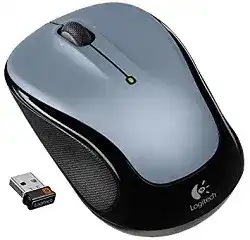
A missing cursor, a dead wheel, or a receiver that appears plugged in but does nothing can make the Logitech Wireless M325 Mouse Driver feel more important than it really is. This model works through a Logitech Unifying USB receiver, not Bluetooth, so the repair should start with the receiver, the AA cell, the power switch, and the small wireless path between the mouse and the computer.
The M325 is a compact wireless mouse with a micro-precise scroll wheel, left and right clicks, wheel click, and wheel tilt for extra actions such as web back and forward on supported systems. The receiver can also pair with other compatible Unifying devices, which is useful after a lost receiver or after moving the mouse between computers.
Windows and other desktop systems can usually move the pointer after the receiver loads as a normal USB input device. Logitech software becomes useful when the receiver has to be paired again, when wheel tilt does not behave as expected, or when the computer sees the receiver but not the mouse behind it.
Logitech Wireless M325 Windows Driver Download
| Driver Name | Description | Supported OS | File Size | Download |
|---|---|---|---|---|
| Logi Options+ Software | Customizes mouse buttons, pointer behavior, scrolling, shortcuts, and device settings on supported Windows systems. | Windows 11, Windows 10 32-bit/64-bit | 43.09 MB |
Logitech Wireless M325 Mac OS Driver Download
| Driver Name | Description | Supported OS | File Size | Download |
|---|---|---|---|---|
| Logi Options+ macOS Installer | Installs Logi Options+ for adjusting mouse buttons, scrolling actions, shortcuts, and device preferences on macOS 12.0. | macOS 12.0 | 18.65 MB | |
| Logi Options+ Smart Installer | Provides a smart macOS 13 installer for setting mouse controls, pointer options, gestures, and shortcut behavior. | macOS 13 | 19 MB | |
| Logi Options+ Software | Enables button assignments, scrolling preferences, pointer tuning, and device customization for macOS 11 systems. | macOS 11 | 17.51 MB | |
| Logi Options+ Software | Supports mouse button customization, gesture setup, shortcut mapping, and scrolling control across listed macOS releases. | macOS 13, macOS 12, macOS 11, macOS 10.15 | 19.44 MB | |
| Logi Options+ Software | Updates device settings, button functions, pointer behavior, scrolling options, and shortcuts for newer macOS versions. | macOS 26, macOS 15, macOS 14 | 19.44 MB |
When the receiver lights up nothing and the pointer stays still
Do not start by changing every mouse setting. Unplug the Unifying receiver, place it in a direct USB port, then switch the M325 off and on from the bottom. The receiver is tiny enough to sit beside other USB devices, but crowded ports and metal cases can weaken the short wireless link before software ever sees the device.
If the pointer still refuses to move, open the Unifying pairing utility and pair the mouse again. The Logitech Wireless M325 Mouse Driver package should be treated as receiver recovery software in this case, because the device may have lost its pairing or may be trying to talk to a different Unifying receiver from an older keyboard or mouse set.
Logitech Wireless M325 Mouse Software for Pairing Recovery
A common mistake is using Bluetooth menus for this model. The M325 does not pair through Windows Bluetooth or macOS Bluetooth settings. It needs the Unifying receiver in the USB port, and the pairing utility must talk to that receiver before the mouse can respond.
If the original receiver has been lost, use a replacement Unifying receiver with the orange star logo. A plain Logitech nano receiver from another non-Unifying mouse is not the same thing. The mouse may look identical from the outside, but the pairing utility can only attach the M325 to a compatible Unifying receiver.
Receiver already paired to another device
A Unifying receiver can remember multiple compatible Logitech devices, so an old keyboard and the M325 can share one receiver when pairing is done correctly. Trouble starts when a user swaps receivers and expects the mouse to follow automatically. Pairing belongs to the receiver, not to the USB port.
Open the Unifying software, remove unused entries if the utility shows them, then add the M325 again by turning the mouse off and on during the pairing prompt. Keep the receiver connected while doing this. Pulling it out during pairing can leave the utility waiting for a device that never finishes registering.
Mouse works on one computer but not another
When the same M325 works on a different computer, the hardware has probably survived. The problem is more likely the USB port, an older receiver entry, blocked input permissions, or a driver cache issue on the first machine. Restart once after installing the Logitech utility, then test the receiver again before changing more settings.
On laptops, a side USB port often gives the receiver a clearer path than a hub behind a monitor. Avoid stacking the receiver beside external drives, wireless adapters, and charging cables while troubleshooting. Once the connection works, you can decide whether a hub is still safe for regular desk use.
Scroll Wheel, Tilt Actions, and Page Jump Problems
The M325 scroll wheel is one of the main reasons people look for software instead of leaving the mouse on system defaults. It is built for line-by-line scrolling, and it also tilts left and right. On many setups, wheel tilt acts like browser back and forward rather than true sideways scrolling.
If tilt does nothing, first test it in a web browser with a few pages opened in the same tab. Some programs ignore tilt commands or use them differently. A spreadsheet, photo viewer, and browser may not react the same way, so one failed program does not prove the wheel is broken.
Wheel tilt does not match the expected action
The Logitech Wireless M325 Mouse Driver can help when the operating system only loads default click and scroll behavior. Use the Logitech control software available for the system to check wheel assignments, then set tilt actions to the function you actually want. On some Mac setups, back and forward through wheel tilt may not work the same way as on Windows.
Do not confuse wheel tilt with middle-click scrolling. Pressing the wheel down and tilting it sideways are different actions. If the wheel press opens a link or activates auto-scroll, that does not mean horizontal movement has been enabled. Test each wheel action separately before deciding which one needs software control.
Scroll jumps, sticks, or moves the wrong way
Bad scroll behavior is not always a driver fault. Dust around the wheel, a worn wheel surface, and app-specific scroll settings can all make the wheel feel inconsistent. Blow loose dust away from the wheel gap, roll the wheel several times, then test in a plain document or settings window before reinstalling software.
If scrolling reverses direction after using another mouse or trackpad, check the operating system’s scroll direction setting. The M325 follows the system setting in many programs, so the wheel can feel wrong even when the hardware is reading every notch normally.
Pointer Movement, Clicks, and Battery Contact Checks
A cursor that hesitates across the screen usually needs a physical check before a software repair. Use the mouse on a plain, non-glossy surface and remove glass, mirror-finish desks, and patterned mouse pads from the test. Optical tracking can lose detail on shiny or uneven surfaces.
When the pointer freezes after the mouse wakes from rest, cycle the power switch and wait a few seconds for the receiver to see it again. The M325 uses one AA battery, so weak voltage can show up as delayed wake, sudden pauses, or clicks that register only part of the time.
Clicks work only after pressing hard
First slow down the double-click speed in the operating system’s mouse settings. A click that opens two windows, closes items unexpectedly, or refuses to drag may be a click-speed problem rather than a missing driver. Test single click, double click, and drag in a folder window after changing the setting.
If the button still behaves badly on a second computer with the same receiver and battery, the switch may be worn. Software cannot repair a failing physical click switch. It can only change how the system interprets clicks that the hardware already sends cleanly.
Battery looks fine but the mouse will not wake
Open the battery cover and check that the AA cell sits firmly against both contacts. If the mouse has been stored for a long time, clean only light contact residue with a dry cloth and avoid liquid inside the compartment. A slightly loose cell can make the mouse cut out when moved.
The receiver storage slot inside the mouse is only for carrying the Unifying receiver. If the receiver is still stored there, the computer has no wireless link to the mouse. Remove it from the storage slot and plug it into the computer before checking software again.
Install the Logitech Wireless M325 Mouse Driver Only After the Hardware Path Is Clear
Install the Logitech Wireless M325 Mouse Driver after the receiver, power switch, AA cell, and USB port have passed a quick check. That order saves time because Logitech software cannot detect a mouse that has no working receiver connection or no power at the device.
After installation, keep the Unifying receiver connected and run the pairing utility if the mouse still does not respond. Then check wheel tilt, wheel click, pointer speed, and normal left and right clicks. The goal is not to load several mouse utilities at once; the goal is to leave the M325 paired to the receiver that is actually in use.
If the M325 keeps dropping out after pairing, focus the last check on receiver compatibility, USB position, desk interference, and the battery contacts. Those four areas match the way this model connects. Bluetooth fixes, gaming profile tools, charging advice, and Bolt receiver steps do not belong on this mouse.