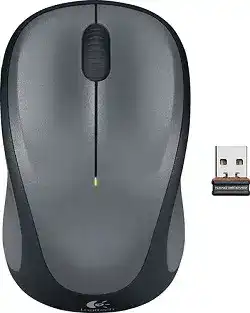
When the small USB receiver is plugged in but the cursor still sits still, the Logitech Wireless M315 Mouse Driver search usually starts after the hardware path has already failed once. This model is a receiver-based wireless mouse with a USB Nano receiver, a bottom power slider, one AA battery, a battery warning light, a scroll wheel with middle-button use, and receiver storage inside the battery area.
The M315 is not a Bluetooth mouse, so Bluetooth discovery screens will not bring it online. The computer must see the Nano receiver through USB first, then the mouse must have power and a clear enough wireless link to that receiver. Most repairs should stay close to those parts instead of jumping into unrelated Logitech tools.
A normal operating system can handle basic left click, right click, pointer movement, and wheel scrolling after the receiver is accepted. Extra software becomes useful only when the receiver connection has to be restored on supported Windows systems or when the wheel button behavior depends on the program being used.
Logitech Wireless M315 Windows Driver Download
| Driver Name | Description | Supported OS | File Size | Download |
|---|---|---|---|---|
| SetPoint 32-bit Software | Full SetPoint package for offline setup with mouse button settings, tracking speed, hot-key controls, and device-specific options. | Windows 11, Windows 10 32-bit, Windows 8 32-bit, Windows 7 32-bit | 78.04 MB | |
| SetPoint 64-bit Software | Offline SetPoint installer for configuring mouse controls, pointer behavior, battery status, Caps Lock alerts, and Num Lock notifications. | Windows 11, Windows 10 64-bit, Windows 8 64-bit, Windows 7 64-bit | 80.45 MB | |
| SetPoint Smart Installer | Small SetPoint web installer for mouse settings and device controls; internet access is required during installation. | Windows 11, Windows 10 32-bit/64-bit, Windows 8 32-bit/64-bit, Windows 7 32-bit/64-bit | 4.61 MB |
Receiver in storage instead of the computer
This model has a slot for the Nano receiver inside the mouse, which is useful for travel but confusing during setup. If the receiver is still stored under the battery cover, the mouse has no path to the computer. Remove the receiver from the storage area and plug it into a real USB port before checking anything else.
After plugging in the receiver, switch the mouse on from the bottom. The power slider is small and easy to miss, especially after changing the battery. If the switch stays off, the computer may detect the receiver while the mouse itself remains completely silent.
USB Port and Power Checks Before Reinstalling Anything
Start with the port, not the download. Pull the Nano receiver out, wait a moment, and insert it into a direct USB port on the computer. If it was sitting in a hub, keyboard port, monitor port, or docking station, use the computer’s own USB port for the first test.
A hub can work later, but it adds another point of failure while troubleshooting. Some hubs save power aggressively, and some sit too far from the mouse. The M315 works better when the receiver has a short, clear path from the desk to the device.
Changing ports after Windows sees the receiver
Windows may make the receiver look fine even when the mouse behind it does not respond. Move the receiver to another USB port and give the system a few seconds to refresh the input device. Then turn the mouse off and on once so the receiver gets a new wake signal.
If the receiver works only in one port, leave it there while finishing the setup. Do not keep moving it during pairing or reconnection. Constant port changes can make the system reload the USB input profile while you are trying to test the mouse.
Metal objects and desk position
The official setup notes for this type of receiver call out metallic objects between the mouse and receiver for a reason. A metal desk frame, laptop stand, external drive case, or crowded cable area can weaken the signal enough to create freezing, delayed clicks, or a pointer that moves only sometimes.
Clear the area between the mouse and the receiver during testing. If the computer sits under a desk, use a short USB extender for the Nano receiver instead of burying it behind the case. The fix is often receiver position, not another copy of the Logitech Wireless M315 Mouse Driver.
Battery Door, Red Light, and Wake Problems
The M315 uses one AA battery, and the battery direction matters. Open the battery cover and match the battery ends with the markings inside the compartment. A battery that is reversed, loose, or barely touching the contacts can make the receiver appear dead even when the USB side is fine.
The top battery light can flash red when battery power is low. Do not wait until the mouse completely stops. A weak AA cell can cause short freezes, missed clicks, slow wake after idle time, or a pointer that works for a minute and then quits again.
Mouse works after pressing the battery cover
If the mouse wakes only when you press near the battery door, the cell may not be sitting firmly. Remove the battery, check the spring and contact ends, then place the AA cell back into the compartment. Keep the cover seated flat so movement on the desk does not shake the connection loose.
Light dust or dry residue on the battery contacts can also interrupt power. Wipe the contact area gently with a dry cloth. Avoid pouring cleaner into the compartment, because liquid near the battery contacts can create a worse problem than the original dropout.
Delayed wake after sitting unused
A short pause after idle time can be normal for a battery mouse, but repeated wake failure is not. Turn the mouse off, wait a few seconds, then turn it on again. If that wakes it every time, check the AA cell and receiver position before blaming software.
When the mouse needs a power cycle several times a day, test it on another computer with the same receiver and battery. If the same pause follows the mouse, focus on power and hardware. If the second computer works normally, the first machine’s USB port or power management is more likely involved.
Scroll Wheel and Middle-Click Behavior on the M315
The scroll wheel on this model also works as a middle button, and the manual notes that its function can vary by software application. That means a wheel press may open a browser link, activate auto-scroll, close a tab, or do nothing depending on where you test it.
Check the wheel in more than one place before deciding it is broken. A browser, a folder window, and a plain document can respond differently. The Logitech Wireless M315 Mouse Driver should not be treated as a cure for every wheel symptom when the program itself controls the middle-button action.
Wheel scrolls badly in only one program
If scrolling feels wrong in one app but normal elsewhere, look inside that app’s scroll or navigation preferences first. Some programs change line scrolling, page scrolling, zoom behavior, or middle-button actions. A system-wide reinstall will not fix a setting that belongs to only one application.
For rough wheel movement everywhere, turn the mouse off and clear dust around the wheel gap. Roll the wheel several times after cleaning the outside. Do not take the mouse apart for a normal scroll complaint unless you have already ruled out surface dust, program settings, and battery weakness.
Middle button opens the wrong action
A wheel press is not the same as left or right click. If the middle button opens a link in a new tab or activates a special scroll mode, that is often normal software behavior. Test it in a browser first, then in another simple window to see whether the action follows the program.
If the wheel press never registers anywhere, check whether the wheel still scrolls normally. A wheel that scrolls but will not press may have a physical switch problem. Software can change how a middle click is used, but it cannot repair a switch that no longer sends a click.
Reconnection Utility, Wrong Receiver, and Final M315 Checks
For supported older Windows setups, Logitech provided a connection utility to reconnect the M315 with its Nano receiver. Use that kind of tool only for receiver reconnection. It is different from Bluetooth pairing, and it is not the same as loading software meant for newer multi-device mice.
The receiver should match the mouse. A random Nano receiver from another Logitech model may fit into the USB port and still fail to communicate with the M315. If the receiver has been mixed with other mice in a drawer, test with the original receiver first whenever possible.
Pointer moves unevenly after the receiver connects
Try another surface before changing speed settings. Glossy tables, glass, mirror-like pads, and heavily patterned surfaces can confuse optical tracking. Use a plain mouse pad or a matte sheet of paper for testing, then adjust pointer speed only after tracking becomes steady on a good surface.
If the cursor still feels too fast or too slow on a good surface, use the operating system’s mouse settings. That adjustment changes pointer speed without touching the receiver connection. Keep connection repairs and pointer preference changes separate so you know which change fixed the problem.
Clicking opens items twice or will not drag cleanly
Double-click speed can make a working button feel faulty. Slow the double-click setting in the operating system and test again in a folder window. If dragging files or selecting text becomes normal, the mouse hardware was probably sending clicks correctly and the timing was the problem.
If left click still fails on another computer, with a known-good AA battery and the same receiver, the button switch may be worn. At that point, another Logitech Wireless M315 Mouse Driver install will not change the mechanical click coming from the mouse.
Finish the M315 repair by keeping the Nano receiver in a direct, clear USB position, using a properly seated AA battery, and testing the wheel in more than one program. The Logitech Wireless M315 Mouse Driver belongs after those checks, mainly for supported receiver reconnection and ordinary mouse control rather than Bluetooth, gaming profiles, charging fixes, or Unifying receiver steps.