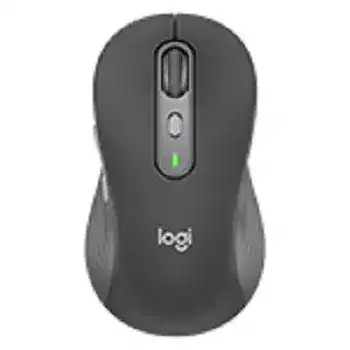
When custom buttons disappear or the control app cannot see the device, the Logitech Signature M750L Mouse Driver restores access to its SmartWheel, pointer sensitivity, shortcuts, and application profiles. The mouse can work through Bluetooth Low Energy or a Logi Bolt receiver, while three connection channels let it move between paired computers. Logi Options+ handles the extra controls that ordinary operating-system mouse support does not expose.
Logitech Signature M750L Mouse Windows Driver Download
| Driver Name | Description | Supported OS | File Size | Download |
|---|---|---|---|---|
| Logi Options+ Software | Customizes mouse buttons, pointer behavior, scrolling, shortcuts, gestures, and device settings. | Windows 11, Windows 10 32-bit/64-bit | 43.21 MB |
Logitech Signature M750L Mouse Mac OS Driver Download
| Driver Name | Description | Supported OS | File Size | Download |
|---|---|---|---|---|
| Logi Options+ Software | Adjusts mouse buttons, pointer response, scrolling behavior, gestures, shortcuts, and connected-device preferences. | macOS 26, macOS 15, macOS 14 | 19.56 MB | |
| Logi Options+ Software | Manages button assignments, scrolling controls, pointer movement, application shortcuts, and mouse-specific options. | macOS 13 | 19 MB | |
| Logi Options+ Software | Sets up custom mouse actions, gesture commands, pointer preferences, scrolling modes, and application controls. | macOS 12 | 18.65 MB | |
| Logi Options+ Software | Controls mouse button functions, cursor behavior, scrolling adjustments, gesture actions, and device configuration. | macOS 11 | 17.51 MB |
Logitech Signature M750L Mouse Driver When Options+ Cannot Find the Device
The pointer may work normally even when Logi Options+ shows no connected mouse. This usually means the operating system has loaded standard pointing functions, but the control app has not completed device detection. Close Options+, switch the mouse off for several seconds, turn it on again, and reopen the app. Restarting the computer after installing or updating the software also refreshes its background services.
Match the software with the active connection
Check which numbered channel is lit underneath the mouse before changing the software. A short press on the connect button moves between channels 1, 2, and 3. The channel selected on the mouse must contain the pairing for the computer running Options+. Otherwise, the pointer may control another nearby machine while the current computer shows the device as unavailable.
For a Bluetooth connection, open the computer’s Bluetooth panel and confirm that the listed model matches the model number printed underneath the mouse. Remove an abandoned or duplicate pairing when the device appears several times, place the chosen channel into pairing mode with a three-second press, and add it again. This gives the Logitech Signature M750L Mouse Driver a newly created connection to detect.
Use Logi Options+ rather than retired utilities
Logi Options+ is the appropriate control application for this model. Older packages such as SetPoint, Logitech Options, Unifying Software, and Logitech Connection Utility do not provide the intended M750L configuration path. Keeping several generations of Logitech software on one computer can also leave competing background components. Remove software that no longer serves another device, restart the computer, and then install the current Options+ package.
When an Options+ update leaves the device panel empty, first quit the application completely rather than opening another installer over it. Start the app again and check for a newer maintenance release. If detection remains broken, uninstall Options+, restart Windows or macOS, and reinstall it. The mouse should stay paired during this process, so avoid deleting a working Bluetooth or Bolt connection unless the operating system also fails to move the pointer.
Repair Bluetooth, Bolt, and Three-Channel Switching
Bluetooth pairing mode ends too quickly
A rapidly flashing channel light means the mouse is ready for Bluetooth pairing. A steady or slow-changing light usually means that channel already holds a connection or has left discovery mode. Hold the connect button for about three seconds while the intended channel is selected. Keep the computer’s Bluetooth window open during this step, then choose the M750L entry that matches the marking under the device.
If the computer asks for the mouse repeatedly but never completes the connection, remove the previous Bluetooth record first. Turn Bluetooth off and back on, restart the mouse, and begin pairing again. On laptops, also disable airplane mode and confirm that Bluetooth has not been turned off by a power-saving control or hardware shortcut.
A Logi Bolt receiver works on one channel
The included Logi Bolt receiver normally arrives associated with channel 1. Insert it directly into a working USB port and select that channel underneath the mouse. Do not try to connect the M750L through a Unifying receiver; the two receiver systems are different. If the original Bolt pairing has been cleared, use the device-adding function in Logi Options+ or the Logi Bolt app to associate the mouse again.
Intermittent movement through the receiver can come from its position rather than the Logitech Signature M750L Mouse Driver. A receiver hidden behind a metal desktop, docking station, or crowded group of USB devices may receive a poor signal. Try another port with a clearer path to the mouse. A short USB extension can also place the receiver away from external drives, hubs, and other equipment that produces radio noise.
Switching computers opens the wrong channel
A short press changes channels; a long press starts pairing. Holding the button too long while changing computers can erase the expected behavior by placing that channel into discovery mode. Press briefly, watch which channel number lights, and wait for the saved computer to respond. Each channel can hold one Bluetooth or Bolt connection, but the mouse does not display the computer name, so assign the channels in a memorable order.
Logitech Signature M750L Mouse Software for SmartWheel and Button Actions
The M750L has a SmartWheel, a DPI button, and back and forward buttons. Logi Options+ can change their actions and create different assignments for individual programs. Without the app, the main clicks, pointer, and wheel may still work, but horizontal scrolling, gestures, custom shortcuts, and application-specific commands may be missing or behave differently.
Fast scrolling starts unexpectedly
SmartWheel changes its feel according to how quickly the wheel turns. Slow movement produces distinct line-by-line steps, while a quick flick reduces resistance and travels through long pages faster. This automatic change can look like a fault when a document suddenly moves farther than expected. Use a lighter wheel motion for precise reading, or adjust the scrolling options in Logi Options+ when the application offers a suitable control.
Scrolling that reverses direction, misses several turns, or behaves badly on every computer needs a separate check. Test a long local document and a browser page before blaming one program. Remove loose dust around the wheel with gentle air and rotate it several times without pressing hard. If the same irregular movement remains through Bluetooth and Bolt on another computer, the wheel mechanism may need service rather than another software installation.
Horizontal scrolling needs a button and wheel combination
This model does not use a separate thumb wheel. Horizontal movement works by holding a configured side button while turning the SmartWheel. Open the Point and Scroll area in Options+ when this action does nothing. Confirm that horizontal scrolling remains assigned, then test it in a wide spreadsheet or another window that actually contains content beyond the visible left and right edges.
Back and forward buttons change between programs
Options+ can load application-specific profiles, so a side button may navigate web pages in one program but perform undo, redo, media, or meeting controls elsewhere. Open the mouse page in the app and inspect both the general assignment and the profile for the affected program. Delete or change the program profile when you want the same action everywhere.
On macOS, custom commands can stop even though the ordinary clicks still respond. Open Privacy and Security and review the permissions requested by Logi Options+, especially Accessibility, Input Monitoring, and Bluetooth access. Re-enable the entries after a macOS upgrade if necessary, quit the app when prompted, and launch it again. Screen recording permission may also be required for a button assigned to capture a particular window or on-screen area.
Pointer Pauses, Flow Failure, and Battery Wake Problems
The pointer pauses after sleep
The mouse enters a deeper power-saving state after a long period without activity. A click or small movement should wake it, although Bluetooth may take a moment to restore the link. When it never returns, switch the device off and on, confirm the selected channel, and check whether the computer still lists the pairing. Reconnect only the affected channel instead of clearing all three saved connections.
A pulsing red battery indicator points to a low charge in the replaceable AA battery. Open the compartment, check the polarity markings, and make sure both contacts touch the battery ends firmly. Fit a new alkaline AA cell when wake failures, delayed clicks, or brief disconnections continue. The battery warning inside Options+ can provide earlier notice before the connection becomes erratic.
Tracking becomes uneven on a difficult surface
The 4000 DPI sensor still depends on a usable surface. Reflective glass, polished material, and highly repetitive patterns can produce jumps or missed movement. Test the mouse on plain paper or a conventional mouse pad. If tracking improves immediately, keep the software installation and change the work surface rather than repeatedly altering Bluetooth pairings or receiver associations.
Pointer speed can also feel wrong after Options+ restores a profile or the DPI button receives a new function. Check the pointer setting in the Logitech app and the operating system before creating another pairing. Adjust one control at a time, then move across the screen to judge the result. Changing both controls together can make acceleration or sensitivity harder to diagnose.
Flow stops at the screen edge
Logitech Flow requires Options+ on both computers, an active network path between them, and the mouse paired with each machine on separate channels. Confirm that each installation detects the M750L before enabling Flow. Firewalls, guest wireless networks, VPN rules, and isolated office networks can prevent the two computers from discovering each other even though manual channel switching still works.
On macOS, Bluetooth and Accessibility permissions must remain enabled for the control app. On either system, keep Options+ running and place the displays in the correct left-to-right arrangement inside Flow. If automatic crossing still fails, switch channels manually to prove both pairings work, then restart the app on both computers. That separates a Flow communication fault from a connection problem.
Restore the Controls You Actually Use
After the Logitech Signature M750L Mouse Driver detects the device, rebuild only the assignments needed for regular work. Check the DPI button, back and forward controls, horizontal scrolling, and any application profiles one at a time. This makes a conflicting profile easier to identify than importing or changing several commands together.
Finish by testing every saved channel and noting which computer belongs to each number. Keep Bluetooth records only for connections still in use, retain the compatible Logi Bolt receiver, and watch the battery indicator when wake delays begin. These checks preserve the M750L’s multi-device switching without turning a small pairing or profile fault into a complete software reset.