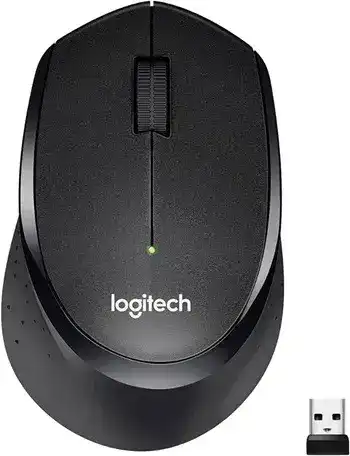
Logitech M331 SILENT Plus Mouse uses a small USB wireless receiver, so it does not need Bluetooth pairing for normal use. Windows, macOS, ChromeOS, and Linux usually detect the receiver as a standard pointing device. The Logitech software package mainly matters when you need receiver pairing, device recognition help, or basic mouse control checks.
This model is a right-hand wireless mouse made for quiet work, study, browsing, and office tasks. It has silent left and right clicks, a rubber scroll wheel with middle-click control, optical tracking, and a single AA battery design. It also uses a compact USB receiver for 2.4 GHz wireless connection.
For basic movement and clicking, the system driver normally handles the device. However, the right Logitech utility can help when the receiver loses pairing, Windows keeps old Logitech entries, or the mouse does not respond after a battery or USB port change.
Logitech M331 SILENT Plus Mouse Windows Driver Download
| Driver Name | Description | Supported OS | File Size | Download |
|---|---|---|---|---|
| Logitech Options Software | Customize mouse buttons, pointer behavior, scrolling, shortcuts, and device settings on supported Windows systems. | Windows 10 32-bit/64-bit, Windows 8 32-bit/64-bit, Windows 7 32-bit/64-bit | 187.71 MB | |
| Logitech Options Software | Manage compatible mouse settings, scrolling behavior, button assignments, and productivity shortcuts in Windows 11 and 10. | Windows 11, Windows 10 32-bit/64-bit | 245.76 MB |
Logitech M331 SILENT Plus Mouse Mac OS Driver Download
| Driver Name | Description | Supported OS | File Size | Download |
|---|---|---|---|---|
| Logitech Options Installer | Set up Logitech Options to adjust mouse buttons, pointer response, scrolling preferences, and device controls on macOS. | macOS 15, macOS 14, macOS 13, macOS 12, macOS 11 | 238.52 MB |
Setting Up the M331 Receiver and Logitech Utility
Start with the receiver because this model depends on it. Plug the USB receiver directly into the computer when possible, then turn the mouse on from the bottom switch. If the pointer moves, you can use the mouse without extra software. After that, install Logitech software only when you need pairing or control troubleshooting.
Choose software only when it is needed
The M331 does not need a special driver for ordinary pointing, clicking, and scrolling. Windows may use its built-in mouse driver, while macOS, ChromeOS, and Linux usually handle the receiver in a similar plug-and-play way. If your download page offers a Logitech pairing utility, use it mainly for receiver connection problems.
If you already have old Logitech utilities on the computer, avoid running several of them together. Remove older tools that no longer detect the receiver, restart the computer, and then try the current Logitech utility again. This often clears receiver detection problems that stay after repeated failed setup attempts.
Pair the receiver carefully
Some M331 packages use a receiver that can pair through Logitech’s receiver utility. Check the receiver and mouse for the matching receiver logo before pairing it with a replacement receiver. If the receiver type does not match, the software may open normally but never find the mouse.
During pairing, keep the receiver plugged in, switch the mouse off, wait a few seconds, and switch it on again when the utility asks. Use a fresh AA battery before pairing. Weak batteries can make the mouse power light or switch seem fine, but the receiver still may not complete the connection.
Test before changing more settings
After setup, test the pointer, left click, right click, scroll wheel, and middle click in a simple browser window or text page. This gives you a clean result before you blame a game, remote desktop app, design program, or browser extension. Also test the receiver in another USB port if movement feels delayed.
Keep the receiver close to the mouse when you use a desktop tower. Rear USB ports, metal desks, docking stations, and nearby USB 3.0 storage can weaken a 2.4 GHz wireless signal. A front USB port or short USB extension often gives the receiver a clearer path.
M331 Problems and Practical Fixes That Usually Work
Most M331 problems come from receiver pairing, weak power, USB interference, old software entries, dirty wheel parts, or normal button wear. Try the simple checks first, because many faults look like driver problems when the receiver or battery actually needs attention.
Mouse turns on but the pointer does not move
When the mouse powers on but the pointer stays still, remove the receiver and the AA battery for a few seconds. Then place the battery back in the correct direction, plug the receiver into a direct USB port, and switch the mouse on again. This resets both sides of the connection.
If nothing changes, test the receiver on another computer. If the mouse works there, the first computer may have a USB driver or old Logitech software issue. If it fails everywhere with a known good battery, the receiver or the mouse hardware may need replacement.
Receiver does not connect after using another receiver
A Logitech mouse does not pair with every small Logitech receiver. The receiver type must match the device. If the original receiver was lost, use a matching replacement receiver and pair it through the receiver utility. Do not expect a random nano receiver from another mouse to work.
If the pairing screen cannot find the M331, unplug other Logitech receivers during the process. Then restart the pairing steps and power-cycle the mouse only when the utility asks. This prevents the software from trying to connect the wrong device.
Windows detects the receiver but the mouse still fails
Windows can keep old receiver entries after failed installs, sleep crashes, or software changes. Open Device Manager, remove old Logitech receiver or mouse entries, unplug the receiver, and restart the computer. After Windows loads again, plug the receiver back in and let Windows detect it fresh.
Then open the Logitech utility only if pairing still fails. This order matters because the utility may not see the receiver while Windows holds a broken device entry.
Cursor lags, freezes, or jumps across the screen
Lag often comes from wireless interference rather than a bad driver. Move the receiver away from USB 3.0 drives, docking stations, thick cables, and rear ports on a desktop tower. If possible, use a front USB port or a short extension cable so the receiver sits closer to the mouse.
Also replace the AA battery before changing software. A weak battery can cause short freezes, delayed clicks, and uneven pointer movement. After replacing it, test the mouse on a plain mouse pad because shiny or glass surfaces can confuse optical tracking.
Scroll wheel moves unevenly or jumps the wrong way
A jumping wheel usually points to dust, wear, or a weak battery. First replace the battery and blow gently around the wheel area without pushing liquid into the mouse. Then test scrolling on a long web page. If the wheel improves, dirt or low power caused the problem.
If scrolling still jumps on two computers, the wheel encoder may have a hardware fault. Avoid forcing the wheel or spraying cleaner inside the body. If the mouse remains under warranty, use warranty service before opening it.
Middle click works only sometimes
The M331 uses the scroll wheel as the middle button. If middle click fails, test it in a browser tab by clicking a link with the wheel. Some apps ignore middle click, so a browser gives a better test. Also check that the wheel can press down cleanly without sticking.
Dust around the wheel can make the click feel shallow. Turn the mouse off, remove the battery, and clean around the wheel with dry air and a soft brush. Then reinstall the battery and test again.
Single click becomes double click
Double clicking after one press often comes from button wear or dirt near the switch. First check the operating system double-click speed and set it slower for testing. Then try the mouse on another computer. If the same click problem follows the mouse, software probably did not cause it.
For a mouse still under warranty, avoid opening the shell. If it is older, the fault may come from the internal click switch. Cleaning or switch repair can help some units, but that work needs care and can damage the silent-click feel.
Mouse stops after sleep or after a restart
After sleep, the receiver may not wake cleanly on some USB ports. Unplug the receiver, wait a few seconds, and plug it back in. Also switch the mouse off and on. If this keeps happening, move the receiver to another direct USB port and avoid unpowered hubs.
On laptops, check power saving for USB devices if the receiver disconnects after every sleep cycle. Allowing the USB port to stay active can reduce repeated wake problems.
Pointer moves poorly on a desk surface
The optical sensor works best on normal non-glossy surfaces. Glass, mirror-like desks, patterned mats, and very dark shiny tops can make the pointer drift or stop. Test the mouse on plain paper or a basic mouse pad before changing drivers.
Also check the sensor window on the bottom. Turn the mouse off and remove dust with a dry cotton swab or soft cloth. Do not scratch the lens area, because even small marks can affect tracking.
Battery replacement does not bring the mouse back
Check the battery direction first. The M331 uses one AA battery, and a reversed battery will stop the device from powering correctly. If the battery fits loosely, remove it and inspect the metal contacts. Dust or light corrosion can block power.
Clean the contacts gently with a dry cloth. If needed, use a very small amount of isopropyl alcohol on the cloth, then let the compartment dry fully before inserting the battery. After that, reconnect the receiver and switch the mouse on.