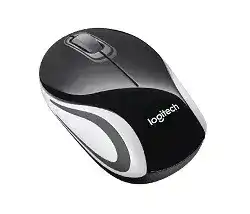
A pocket mouse can fail for a very small reason: the USB receiver is loose, mixed with another Logitech dongle, or not talking to the device anymore. The Logitech WIRELESS MINI M187 Mouse Driver is mainly useful when the computer sees a receiver but the M187 still will not move, scroll, or wake properly.
The M187 is an ultra-portable wireless mouse with a plug-and-play nano receiver, optical tracking, three-button control, a scroll wheel, and one AAA battery. It is not a Bluetooth mouse, and it does not need gaming profiles, RGB tools, charging checks, or a cable setup. Its problems usually sit around the receiver, battery contact, surface tracking, or wheel behavior.
The receiver is meant to stay in the USB port, and it can also store inside the mouse when removed. That tiny size is convenient, but it also makes the receiver easy to misplace or confuse with a similar Logitech receiver from another product. If the M187 stopped working after travel, bag storage, desk cleaning, or laptop sharing, check the receiver identity before changing anything else.
Logitech Wireless Mini Mouse M187 Windows Driver Download
| Driver Name | Description | Supported OS | File Size | Download |
|---|---|---|---|---|
| Logi Options+ Smart Installer | Smart installer for customizing mouse buttons, pointer behavior, scrolling, shortcuts, and device settings; internet is required during installation. | Windows 11, Windows 10 32-bit/64-bit | 43.09 MB |
Logitech Wireless Mini Mouse M187 Mac OS Driver Download
| Driver Name | Description | Supported OS | File Size | Download |
|---|---|---|---|---|
| Logi Options+ Installer | Installer package for adjusting mouse controls, scrolling behavior, pointer response, shortcuts, and supported Logitech device settings on Mac. | macOS 11 | 17.51 MB | |
| Logi Options+ Smart Installer | Smart installer for setting mouse buttons, pointer behavior, scrolling options, shortcuts, and device preferences on macOS 12.0. | macOS 12.0 | 18.65 MB | |
| Logi Options+ Software | Options+ software for managing mouse customization, pointer settings, scroll behavior, app shortcuts, gestures, and Logitech device controls. | macOS 13, macOS 12, macOS 11, macOS 10.15 | 19.44 MB | |
| Logi Options+ Software | Dedicated macOS 13 package for tuning mouse button actions, pointer movement, scrolling preferences, shortcuts, gestures, and device settings. | macOS 13 | 19 MB | |
| Logi Options+ Software | Recent Options+ package for configuring mouse buttons, pointer behavior, scrolling, shortcuts, gestures, and supported Logitech device preferences. | macOS 26, macOS 15, macOS 14 | 19.44 MB |
Computer detects USB but the pointer does not move
When the receiver appears to connect but the pointer stays frozen, unplug the receiver, switch the mouse off, and remove the AAA battery for a few seconds. Put the battery back, turn the mouse on, then plug the receiver into a direct USB port on the computer. This resets both ends of the wireless link without changing system files.
If that does not bring movement back, open the Logitech pairing utility or a current Logitech control app that recognizes the M187. The mouse must be awake during the pairing screen, so switch it off and on only when the software is ready to search. Keep another working mouse or touchpad available because the M187 may not respond until the receiver link finishes.
Lost receiver and replacement receiver confusion
A lost M187 receiver is not solved by any random spare dongle from the drawer. Look for a compatible Logitech Unifying receiver and use Logitech software to pair the mouse to it. If the receiver has no compatible pairing path, the M187 may never appear in the utility even though the USB part itself looks normal.
Many people mistake receiver fit for receiver compatibility. A USB receiver can physically plug in and still belong to a different wireless family. If the pairing screen times out every time, inspect the receiver mark, try another compatible receiver if available, and avoid mixing M187 setup work with receivers from keyboard combos, gaming mice, or non-Unifying models.
Small Mouse, Small Battery, Sudden Dropouts
The M187 uses a single AAA battery, so weak power can create strange symptoms before the mouse fully stops. The pointer may pause after a few minutes, clicks may work only when the mouse is held flat, or scrolling may fail while movement still works. Those symptoms can look like software trouble, but the battery compartment should be checked first.
Open the top cover and make sure the AAA cell sits firmly against both contacts. A battery that works in another device can still fail here if the spring pressure is weak or the ends are dusty. Use a clean dry cloth on the contact area, fit the battery with the polarity marks aligned, and close the cover until it sits flush.
Mouse wakes late after sitting idle
A short wake delay after the M187 has been idle is normal for a small wireless mouse that saves power. Move it once and wait a moment before unplugging the receiver. If the delay becomes long or the device only wakes after several clicks, install a good AAA cell and check whether the power switch feels loose.
Laptop sleep can make this worse on some USB ports. If the mouse works after a restart but not after sleep, plug the receiver into another built-in port and leave it there for a full sleep-and-wake cycle. A port that restores USB power cleanly will make the M187 feel far less unpredictable.
Battery drains faster than expected
Frequent travel can leave the switch on while the mouse rubs inside a bag. That drains the AAA battery and may also wake the receiver connection repeatedly. Turn the M187 off before storage, keep the receiver inside the mouse when it is removed from the laptop, and avoid carrying it with the wheel pressed down by other items.
Logitech WIRELESS MINI M187 Mouse Software for Pairing and Basic Checks
The Logitech WIRELESS MINI M187 Mouse Driver should not be treated like a large customization suite. The M187 has simple controls, so software is most useful for pairing, receiver recovery, and confirming that the computer can identify the device. Normal left click, right click, pointer movement, and wheel scrolling usually run through the operating system once the receiver link is stable.
If Logitech software cannot find the mouse, do not keep reinstalling the same package without changing the test condition. Use a direct USB port, wake the mouse with the power switch, and remove other spare receivers from the computer while pairing. Too many similar receivers can make the setup confusing, especially when several Logitech devices have been used on the same laptop.
Logitech utility sees the receiver but not the mouse
This usually means the receiver side is alive while the mouse side is asleep, unpowered, or not compatible with that receiver. Turn the M187 off, wait briefly, start the pairing search, and turn the mouse on during the search window. If nothing appears, change the AAA battery and repeat the process before assuming the mouse is defective.
If the same receiver pairs another device but refuses the M187, clear old pairings only if the software offers that option and you understand which device you are removing. A receiver can hold more than one compatible Logitech device, but a crowded receiver list can make troubleshooting harder when you only want this mini mouse working again.
Scroll Wheel, Middle Click, and Pointer Feel on the M187
The M187 has a regular wheel, not a fast-scroll or tilt-wheel system. That matters when fixing scroll problems because there is no special wheel mode to toggle. If scrolling jumps, skips, or fails in one direction, start with debris around the wheel slot and then check the program where the problem appears.
Turn the mouse off, remove the battery, and roll the wheel several times. Blow loose dust away from the wheel gap and avoid wet cleaner near the opening. After that, test scrolling in a plain document and a web page. If only one program behaves badly, change that program’s scrolling preference instead of pairing the receiver again.
Wheel press works in one app but not another
The wheel button can act differently depending on the software on screen. One app may use it for auto-scroll, another may ignore it, and another may use it as a tab or pan command. The practical test is simple: confirm that the physical press clicks cleanly, then compare it in two unrelated programs.
If the wheel press feels soft, stuck, or uneven, the issue may be mechanical. Dust under the wheel can affect the press before it affects rolling. Clean around the wheel carefully with the battery removed, then check again. Do not spray liquid into the wheel slot because it can leave residue inside the switch area.
Pointer skips on shiny desks or fabric
Optical tracking works best on a dull, even surface. Glass, glossy laminate, patterned cloth, and uneven wood grain can make the pointer jump even when the receiver is fine. Place a plain mouse pad or a matte sheet under the M187 and test short movements before changing software or pairing tools.
If tracking improves on the new surface, adjust pointer speed only after the surface problem is solved. Very high speed can make a tiny travel mouse feel nervous on a small desk. Start near the middle of the system mouse speed slider, then raise it slowly until the cursor covers the screen without overshooting.
Keep the Nano Receiver Matched to This Mini Mouse
The strongest habit for this model is also the simplest one: keep the nano receiver with the M187. Store it inside the mouse when it is not plugged into the laptop, and avoid borrowing receivers from other Logitech products unless you know they are compatible and pairable. Most repeat failures start after the original receiver is lost, swapped, or left in another computer.
Use the Logitech WIRELESS MINI M187 Mouse Driver when you need receiver recovery or device recognition help, but do the physical checks first. A direct USB port, the right receiver, a firm AAA battery fit, a clean wheel opening, and a matte tracking surface solve many M187 problems without turning a small mouse setup into a long software repair.
When the mouse is worth testing on another computer
If the M187 still does not move after battery, receiver, USB port, and pairing checks, test it on another computer with the same receiver. A second computer separates a damaged receiver or mouse from a messy operating system profile. If it fails there too, the fault is probably hardware rather than the Logitech WIRELESS MINI M187 Mouse Driver.